GB WhatsApp Privacy Settings Explained: Complete Guide
Why Privacy Settings Matter So Much Here
Privacy is one of the biggest reasons people choose GB WhatsApp over the official app in the first place. Features like hiding your online status or controlling who sees when you have read a message give users a level of control that feels genuinely useful in everyday life. Understanding exactly how these settings work, and their limits, helps you use them confidently rather than guessing.
What This Guide Will Cover
This guide walks through every major privacy setting available in GB WhatsApp and explains exactly what each one actually does. It covers online status, read receipts, typing indicators, profile visibility, and a few lesser known options many users overlook. It also covers a few honest limitations worth knowing before you rely on these settings completely.
Where to Find Privacy Settings
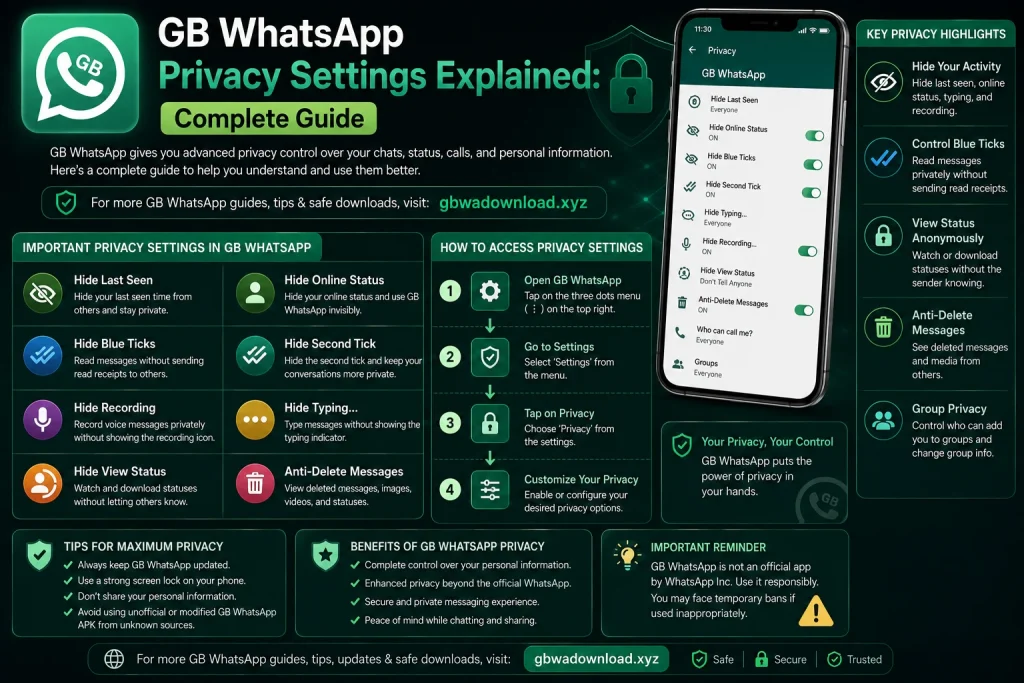
Open GB WhatsApp and go to Settings, then tap Privacy. This menu holds nearly every privacy related option covered in this guide, organized into clearly labeled sections. Spending a few minutes exploring this menu on your own alongside this guide helps everything click into place faster.
Hiding Your Online Status
One of the most requested features is hiding the little indicator that shows when you are actively online. Inside Privacy settings, look for an option labeled Hide Online Status or something similarly worded depending on your version. Turning this on prevents others from seeing when you are currently active inside the app, even while you are actively chatting.
What Hiding Online Status Does Not Do
It is worth understanding that hiding your online status does not necessarily hide other indicators, like your last seen time, unless you adjust that separately. Some versions bundle these settings together, while others keep them fully independent. Checking both settings individually ensures you are not accidentally leaving one indicator visible while thinking everything is hidden.
Controlling Last Seen Visibility
Last seen shows the most recent time you had the app open, which is a separate indicator from real time online status. Within Privacy settings, look for Last Seen and choose who can view it, typically offering options like everyone, contacts only, or nobody. Setting this to nobody gives you the most complete privacy, though it also means you cannot see other people’s last seen time in return in some versions.
The Trade-Off With Mutual Visibility
Many privacy settings inside messaging apps work on a mutual basis, meaning hiding your own information sometimes hides others’ information from you as well. This is worth keeping in mind if you want to hide your own status while still checking when others were last active. Testing this with a trusted contact first helps you understand exactly how your specific version handles this trade-off.
Disabling Read Receipts
Read receipts are the indicators, often shown as blue check marks, that let someone know you have seen their message. Inside Privacy settings, find the option labeled Read Receipts and toggle it off if you prefer not to reveal when you have read something. This is particularly popular among users who want time to think before responding without pressure.
How Read Receipts Affect Group Chats
Disabling read receipts in one on one chats does not always carry over identically into group chats, depending on your specific version. Some versions apply this setting universally, while others require checking a separate toggle for group conversations. Reviewing both areas separately avoids assuming a setting applies everywhere when it might only apply in direct messages.
Turning Off Typing Indicators
The typing indicator, which shows when someone is actively composing a message, is another commonly hidden feature. Look for a setting labeled Hide Typing Status or something similarly named within the Privacy menu. Enabling this prevents others from seeing the small typing bubble that normally appears while you are drafting a reply.
Why Some Users Specifically Want This
Hiding your typing status is popular among people who want to draft and reconsider messages without the other person watching in real time. It removes a subtle layer of pressure that some people find stressful during sensitive conversations. Combined with hidden read receipts, this gives you considerably more breathing room during any conversation.
Managing Profile Photo Visibility
Your profile photo visibility can be adjusted separately from other privacy settings, letting you choose exactly who can see it. Inside Privacy settings, find Profile Photo and select from options like everyone, contacts only, or nobody. This is especially useful if you want to keep a personal photo private from people outside your saved contacts.
Adjusting About Section Visibility
Similar to profile photo settings, the small About text section beneath your profile photo can also be restricted. Locate the About option within the same Privacy menu and choose your preferred visibility level. Many users overlook this specific setting simply because it feels like a minor detail, even though it is adjustable just like everything else.
Controlling Status Update Visibility
If you post status updates, meaning temporary photos, videos, or text visible to your contacts, you can control exactly who sees them. Within Privacy settings, look for Status and choose between everyone, contacts only, or a custom list you build yourself. Building a custom list is especially useful if you want to share updates with close friends while excluding certain other contacts entirely.
Using Custom Lists Effectively
Creating a custom visibility list takes a few extra minutes but gives you far more precise control than the broader default options. This works well for separating personal updates meant for close friends from more general updates meant for a wider group. Revisiting this list occasionally as your contacts change keeps it accurate and genuinely useful.
Blocking Contacts and Managing Blocked Lists
Blocking someone prevents them from seeing your status, profile information, and messaging you altogether. Within Privacy settings, find the Blocked Contacts option to view, add, or remove people from this list. Periodically reviewing this list ensures it still reflects who you actually want blocked, since circumstances and relationships change over time.
Understanding What Blocking Actually Hides
Blocking someone hides your online status, last seen, and profile updates from that specific person, even if your general settings allow others to see them. This makes blocking a useful targeted tool separate from your broader privacy settings. Combining broader privacy controls with specific blocks gives you layered protection rather than relying on just one method.
Hiding Specific Chats From View
Beyond contact based privacy, some versions allow you to hide specific individual chats from your main chat list entirely. This usually involves a lock or hide feature accessible by pressing and holding a specific chat, then selecting the hide option. A password or fingerprint is often required afterward to access these hidden conversations again.
Why This Feature Appeals to Many Users
Hiding specific chats is popular for keeping certain conversations private from anyone who might glance at your phone casually. This works independently from your broader online status and read receipt settings, adding another layer of control. Setting this up for any sensitive conversations gives you meaningful peace of mind beyond the standard privacy menu.
Limitations Worth Understanding Honestly
While these settings offer genuine control, it is worth understanding their real limitations. Privacy settings inside GB WhatsApp only affect what other users see within the app itself, and they do not change how the app itself collects or handles your data behind the scenes. Since this is an unofficial, modified app, there is no independent verification of how your information is actually stored or used internally.
Weighing Convenience Against Uncertainty
The privacy features covered in this guide genuinely work as described in terms of what other users can see. However, the broader question of overall data handling remains something you cannot fully verify with an unofficial app the way you can with a company that publishes clear privacy policies and undergoes official review. This is worth factoring into your overall comfort level, separate from how well these specific visible settings perform.
Reviewing Your Settings Periodically
Privacy preferences often change as your life circumstances shift, whether that means new contacts, changing relationships, or simply wanting more or less visibility over time. Setting a reminder to review your Privacy settings every few months ensures they still reflect what you actually want. This small habit keeps your settings intentional rather than something configured once and forgotten.
Final Thoughts
GB WhatsApp offers a genuinely detailed set of privacy controls, covering everything from online status and read receipts to hidden chats and custom status visibility lists. Taking the time to configure each setting individually, rather than assuming one toggle covers everything, gives you the most accurate and comfortable level of privacy. Just remember that these settings control what other users see, not necessarily how your data is handled behind the scenes, which is worth keeping in mind as you decide how much to rely on this app for sensitive conversations.